
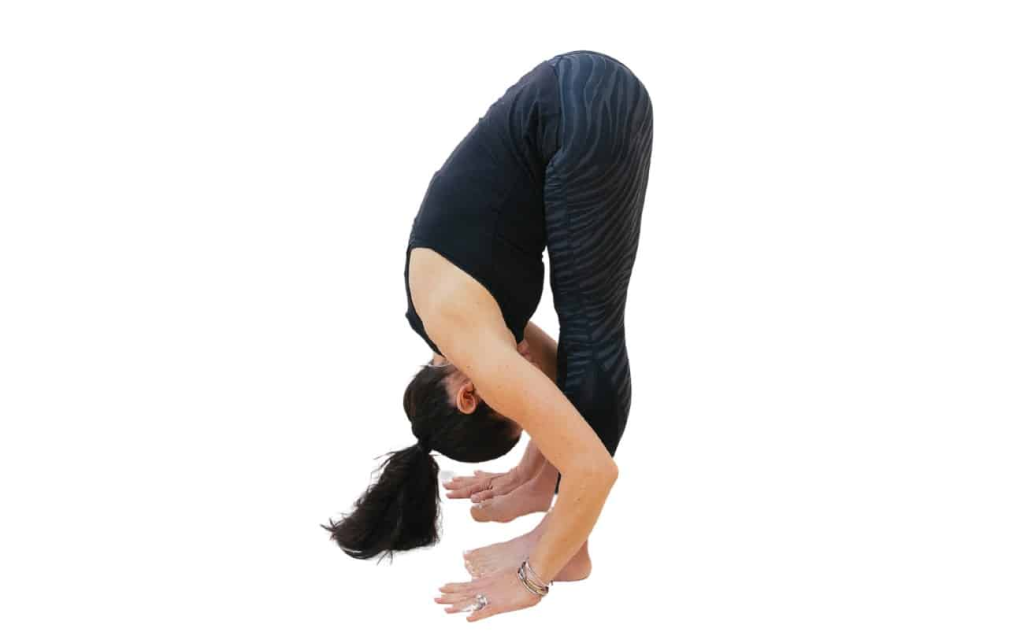
Happier Hamstrings
Many people desire more physical mobility. But most are also unaware just how restricted their range of motion is. The joints, especially the hips and shoulders, are often the primary source of these restrictions. But I’m always surprised by how many adults cannot touch their toes, a movement dependent on the flexibility of multiple joints, but most importantly, the hamstrings. And yet, every human toddler can not only touch their toes, but place them directly into their mouths. So after an enjoyable month of Burpees (one-sided perspective?), we’ll shift to focus on hamstring mobility.
When deciding which area to target, I read a study of just over 2,000 adults aged 51 to 80, which claimed that how well someone could lower themselves to the floor and get back up — a test that leans hard on hip and hamstring range — predicted all-cause mortality over the following six years.¹ Not “correlated with feeling sprightly.” Mortality. In another study with 526 adults, poor trunk flexibility tracked with stiffer arteries in the middle-aged and older groups, independent of how strong or aerobically fit they otherwise were.² Now, your hamstrings are not causing heart disease on their own — they’re the visible end of something larger, and a marker is not a mechanism. But that’s rather the point of a marker. The bathroom scale doesn’t cause anything either, many still look at it.
Stretching on its own is the least interesting version of this. Passive range — the kind you get from hanging in a forward fold thinking about lunch — is not the same as range you can actually use under load. If it’s injury you’re worried about, the evidence is blunt: eccentric strength work cuts hamstring injuries by roughly half, which is more than any stretching protocol has ever managed.³ So this month is not thirty days of reaching for your shins and hoping. It’s ten minutes a day teaching your hamstrings to be long and strong, with the rest of us doing the same thing badly at the same time. You will be stiff on day one. Everyone is stiff on day one. The people who get the most out of these months are never the bendy ones — they’re the ones who show up on day fourteen, mildly annoyed, and do it anyway.
Note: I have done the practice for 30 days a couple of years ago. I’m at a generally good level of fitness, and yet, for the first time in my life, I could fold to touch my chest to my upper legs. So I’m excited to share this one widely.
The Challenge
We are going to see if 10 min of stretching per day for 30 days can noticeably improve flexibility. Can one fold their body further, touching toes that previous seemed so far? Can one observe basic bodyweight movements like standing or strength movements like squats become easier? Can one move with more fluidity? Might certain aches and pains disappear? Let’s give it 10 minutes per day in October to see what changes.
The Routine
I researched multiple videos on YouTube showing various ways to stretch the hamstrings. From these, here is a short routine that can be done in 10 minutes with the intention of convincing the nervous system and the brain, that lengthening and strengthening the leg muscles and increasing flexibility of the lower body will be worth it.
Here is the 10 minute routine to practice each day in October…
For any stretch which feels too difficult at the start, begin with 5-10+ secs of full stretch then rest 1-2 seconds and repeat.
Minute 1: Nerve glides (30 sec each leg)
Minute 2: Knee stretch leg raise (left)
Minute 3: Knee stretch leg raise (right)
Minute 4: Knee stretch push heel down (left)
Minute 5: Knee stretch push heel down (right)
Minute 6: Knee stretch relaxed (left)
Minute 7: Knee stretch relaxed (right)
Minutes 8-10: Hamstring stretches of your choice: standing forward fold, seated forward fold, etc.
Put a ✅ in the group chat when you complete the routine each day. And please don’t hesitate to ask questions in the group chat.
How to prepare
Watch this video first…
Then, watch this…
References
1. Brito LBB et al. Ability to sit and rise from the floor as a predictor of all-cause mortality. European Journal of Preventive Cardiology, 2014;21(7):892–8.
2. Yamamoto K et al. Poor trunk flexibility is associated with arterial stiffening. American Journal of Physiology — Heart and Circulatory Physiology, 2009;297(4):H1314–8.
3. van Dyk N et al. Including the Nordic hamstring exercise in injury prevention programmes halves the rate of hamstring injuries. British Journal of Sports Medicine, 2019;53(21):1362–70.